A field guide to weaponised corporate politeness.
There are two languages spoken in every office.
The first is normal English.
The second is Corporate English — a mysterious dialect where nobody says what they actually mean, but everybody somehow understands exactly what’s being said.
For newcomers, decoding office emails can feel like trying to read ancient cave paintings. That’s why we’ve created this handy survival guide.
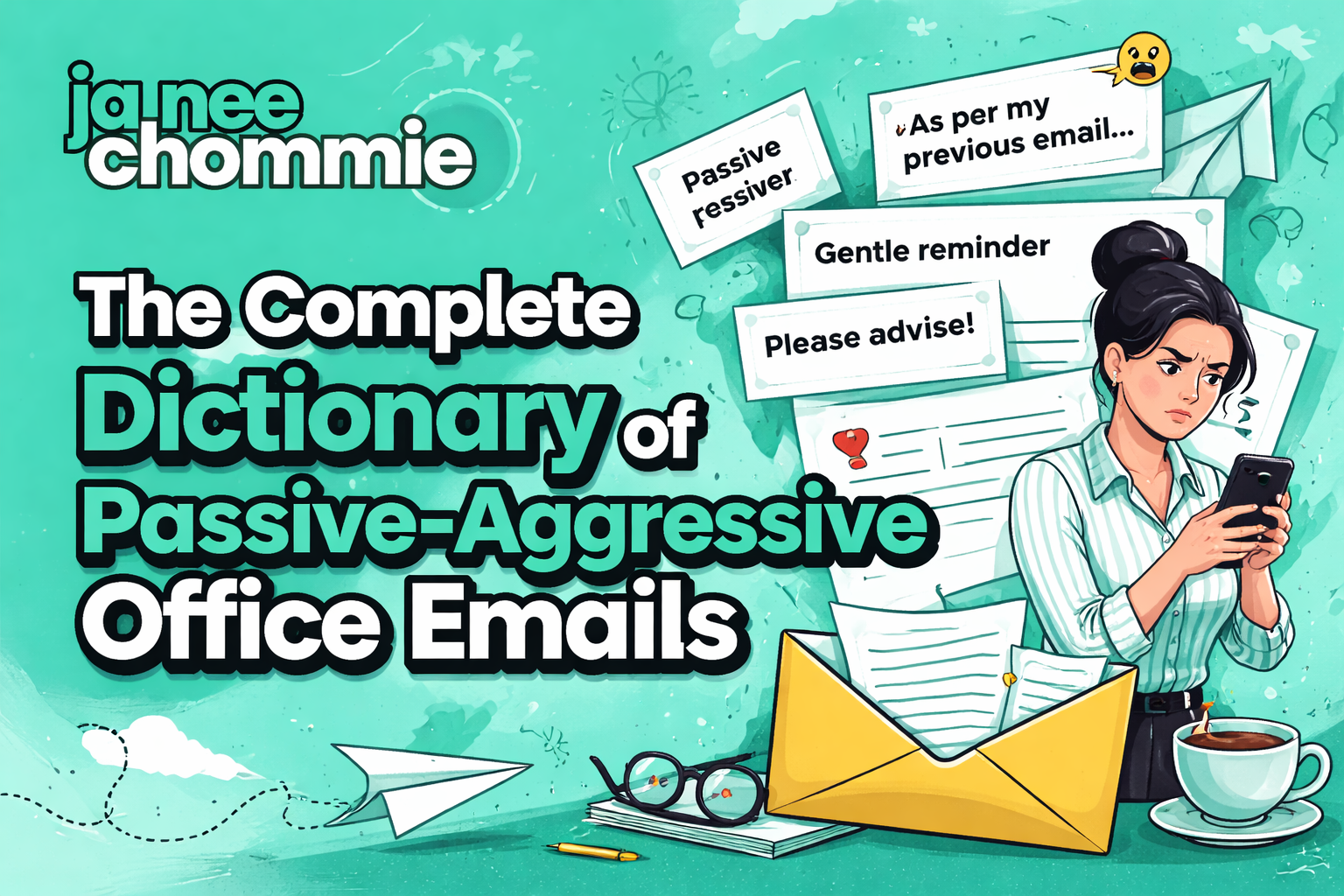
Welcome to the complete dictionary of passive-aggressive office emails.
“As per my previous email…”
Translation: I already told you this. Twice. Possibly three times. I’m now creating a paper trail for when this becomes your problem.
Example:
“As per my previous email, the deadline was Friday.”
Meaning:
“I literally highlighted it in yellow.”
“Just circling back on this.”
Translation: You ignored my first email. Then my second email. This is now my third attempt before I start adding managers to the CC list.
Corporate escalation level: Medium.
“Gentle reminder.”
Translation: This is not gentle.
“Going forward…”
Translation: Somebody messed up. We know who. You know who. We’re not naming names because HR exists.
Example:
“Going forward, please ensure all reports are submitted before month-end.”
Meaning:
“Please stop sending reports three days late.”
“Please advise.”
Translation: I have absolutely no idea what’s happening and I’m making it your problem now.
Also occasionally means:
“I’ve explained this three times and I’m done carrying this project.”
“Kindly.”
South Africans have elevated “kindly” into an art form.
Level 1:
Kindly send through the document.
Friendly.
Level 2:
Kindly send through the document as discussed.
Warning issued.
Level 3:
Kindly send through the document urgently.
You’re in danger.
Level 4:
Kindly refer to the attached correspondence.
Run.
“For awareness.”
Translation: If this explodes later, I want evidence that you knew about it.
“Noted.”
Perhaps the most terrifying email ever created.
Noted.
One word.
No punctuation.
No explanation.
No warmth.
Just pure administrative disappointment.
“Interesting.”
This word has never meant “interesting.”
Not once.
“Thank you in advance.”
Translation: You no longer have the option to say no.
“Can we take this offline?”
Translation: We cannot continue discussing this in front of witnesses.
“Per our discussion…”
Translation: You promised something verbally and I am now documenting it before memory loss mysteriously occurs.
“Please see attached.”
The attachment is missing.
It always is.
“Any updates?”
A simple phrase carrying the emotional weight of:
“It’s been two weeks, chommie.”
“As discussed.”
The corporate equivalent of:
“Remember that thing you agreed to when you were distracted by free snacks?”
“Looping in…”
Translation: Reinforcements have arrived.
“Just a quick question.”
The question will not be quick.
It will require:
- Three meetings
- Four spreadsheets
- One budget review
- An existential crisis
“Happy to discuss.”
The sender is not happy.
Nobody is happy.
Final Thoughts
Office emails aren’t communication.
They’re diplomacy.
They’re emotional chess played through Outlook.
They’re carefully crafted documents designed to say:
“I’m frustrated with you”
without actually saying:
“I’m frustrated with you.”
The next time you receive an email that starts with “As per my previous email…” and ends with “Kind regards,” remember:
The regards are rarely kind.